
2 min drill


2 min drill
2 Min Drill Builds Its Levels Out of Real Football Endings
2 Min Drill is a browser game about calling plays at the end of a real NFL game. There are no platforms to jump across and no defenders to steer around. The level is the situation: a score, a clock, a down and distance, a spot on the field, and a number of timeouts that has already been decided before you touch anything. You pick a play, a real snap from the same kind of moment is played out, and the game grades the call against the best option available.
That makes it a useful case for anyone who cares how levels are laid out, because the terrain here is borrowed rather than designed. The field and the clock are furniture every football fan already knows, so the design work moves into three numbers read off the top of the screen before the first decision.
The 740 Situations and the Three Kinds of Level They Come In
The game's own rules page puts the count at 740 spots, each one a specific moment from a real game, most from the last minutes of recent NFL seasons and a few famous older ones. They are split into three kinds. In a two-minute drill you are behind and have to score before the clock empties. In protect the lead you are ahead and have to burn the clock without handing the ball back. The third kind covers a tie or the end of a half, where the job is to reach scoring range without leaving time for an answer.
Those three kinds are three different level archetypes with the same furniture. The same field, seen from the other side of the score, becomes a completely different problem: a first down on the opponent's 46 is a chance to attack when you are behind, and a thing to avoid when a field goal already wins. That single inversion does more work than most games get out of a new tileset.
The pieces on the field are real too. The twenty-two players are the ones who were on the field for that snap, and each carries a rating between 40 and 99 taken from his percentile at his position in the week of the game. When the result arrives, it is drawn from a library of 160,141 real plays from the 2022 to 2026 seasons, matched on the call, the situation and the defensive look. Nothing in the sequence is scripted for drama.
One Drive, Two Clocks: 4:05 and 3:20 in Overtime
Field Position Is the Terrain: What 'Their 46' Takes Off the Table
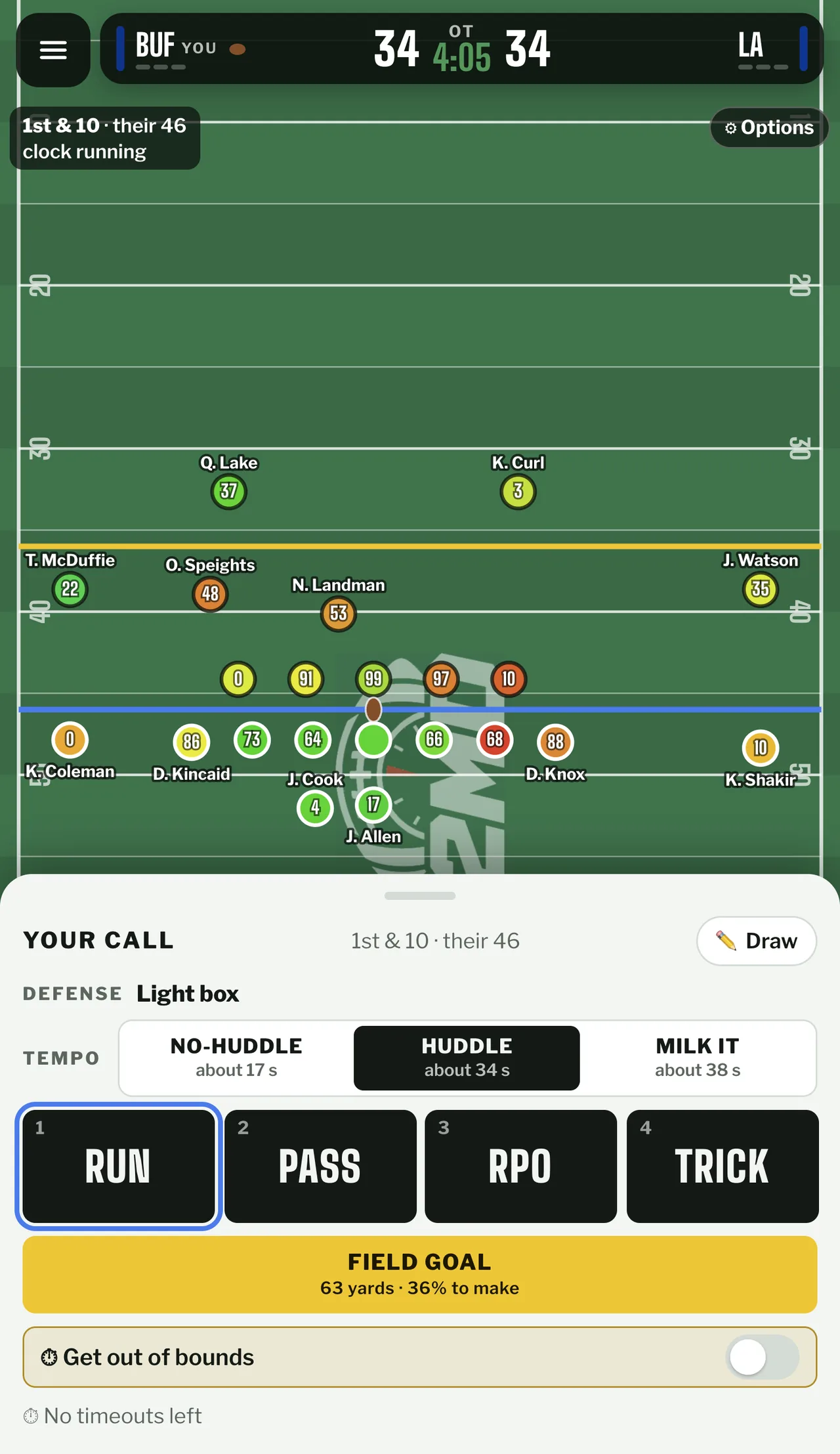
At first and ten on the opponent's 46 with 4:05 left in overtime and no timeouts, the call sheet already tells you something about the terrain. A field goal is offered at 63 yards, with a 36 per cent chance of making it. That is the edge of the map showing through: long enough to be a gamble, short enough that the game refuses to hide it.
Field position works as terrain because it silently deletes options. From the opponent's 46 the end zone is 46 yards away, so a conservative run that gains three keeps the drive alive and costs almost nothing. From your own 10 it is 90 yards away, and the same run is close to a wasted down. No new rule is introduced between those two situations, and yet the correct call changes.
The other half of the terrain is the clock, and it is not a number you read once. The pre-snap frame offers three tempos in plain seconds: no-huddle at about 17 seconds, huddle at about 34, milk it at about 38. Those are not flavour text. They are the level's distance budget, printed so you can spend it deliberately.
Down, Distance and Timeouts: The Numbers That Set the Difficulty
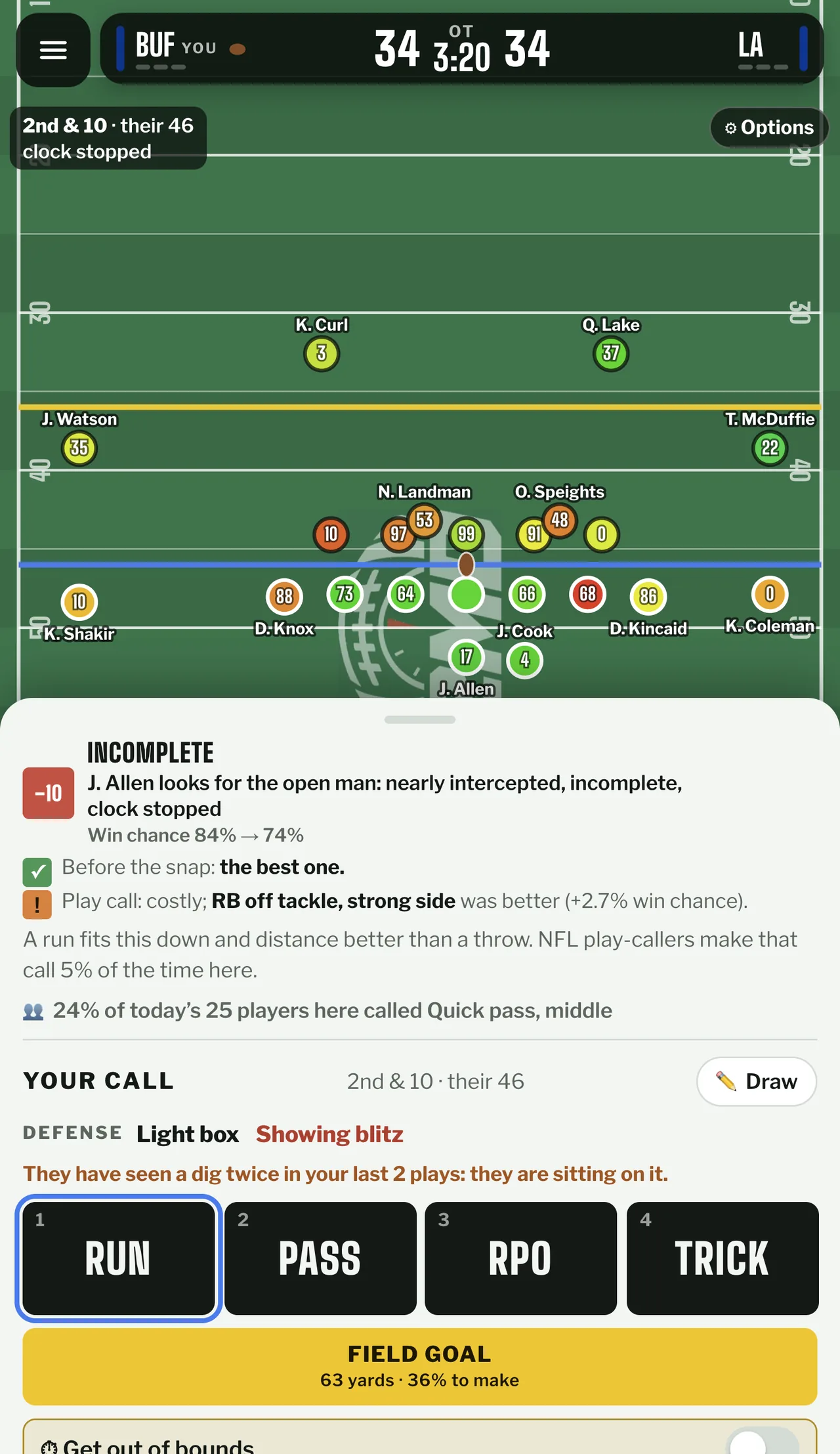
The second frame from the same drive is the clearest illustration of how much three numbers can change. The spot has not moved: still the opponent's 46, still 34-34 in overtime. What changed is the down, from first to second, and the clock, from 4:05 to 3:20, and the fact that the clock is now stopped because the previous pass fell incomplete.
Forty-five seconds is a small slice of a game. In this level it is close to the whole question. At 4:05 with a first down there is room to be patient, and the kind of call that gains a few yards and keeps the chains moving is defensible. At 3:20 on second and long, with the clock stopped and no timeouts in hand, patience is the expensive option and the same field asks for a bigger swing.
The game shows the whole budget at once: down, distance, spot, score, time and timeouts sit in one strip across the top of the field, so a spot's difficulty is visible before you commit. Compare that with a level that reveals its hazard only when it arrives, and it is clear how much of this challenge is reading rather than reacting.
Before the Snap: Personnel, Tempo and the Keys That Reach Them
The inputs are laid out as numbered buttons, and the number keys 1 to 9 map straight onto them, with the space bar skipping the kickoff animation. A mouse or a touch works for everything, so the keyboard is an accelerator rather than a requirement.
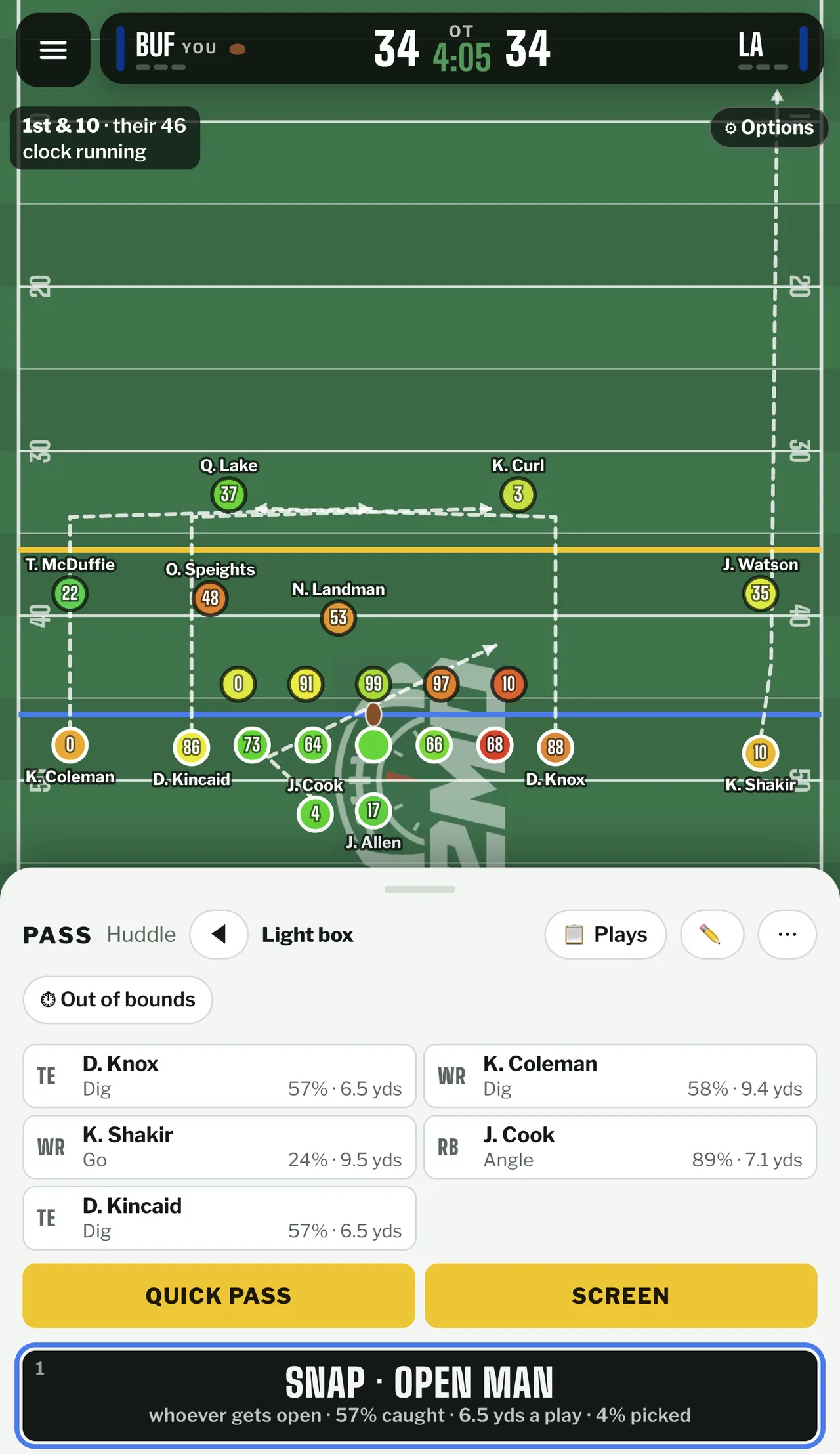
Under the surface the options are wider than four buttons suggest. Personnel can be set to 11, 12, 21 or 13, and the players come from that game's real roster. On a pass, every receiver shows his route on the field, and tapping one changes it. In the paid tier there is a draw tool for sketching a route by hand, and a drawn route is resolved as the closest real route at the depth you drew. Before the snap you can also toggle play action, a rollout, or getting out of bounds.
All of that is setup, and setup hides the game's second layer. The play is one decision; personnel, tempo and route assignments are three more, and they decide whether a spot feels rehearsed or improvised.
How You Can Tell a Level Was Built Well: Win Chance, Not the Result
The grading is the part that turns a set of situations into a set of levels. Before the result appears, the game simulates the rest of the game hundreds to thousands of times for every option available, compares the win chance of your call against the best one, and files the gap into four bands: the best call or within half a point of it, within two points, within five, or worse than five.
The important consequence is that the play's outcome does not move the grade. A well-chosen call that gets intercepted still counts as well-chosen, and a bad call that happens to work still counts as bad. The result frame shows both at once: an incomplete pass with a ten-point drop in win chance, and a note that a run to the strong side would have been 2.7 points better. The verdict arrives before the play is judged, which is the opposite of how most football games score you.
This is the best design decision in the game and also the one that will lose it some players. Grading the decision makes the situations worth studying; it also means a player can do everything right and watch the drive die, which is hard to sell to someone who came for the highlight.
Survivor Chains the Same Terrain Without a Reset
Daily gives you one drive and one score against six thousand simulated coaches, which is a clean single-level format. Survivor removes the reset: it plays random real fourth quarters back to back, and one loss ends the run. A tie at the end of regulation goes to overtime under the league's rules, with both teams getting the ball and the next score winning.
Chaining situations changes what the levels are for. A single spot rewards the best call; a chain rewards consistency, because a brilliant call followed by a careless one ends the session as fast as two bad ones. The spots arrive at random rather than building in difficulty, which makes Survivor closer to an endurance test than a campaign.
Playing Today's Drive Again: Why the Same Spot Can Score Differently
A spot is fixed, but the snap that comes out of it is not. The library holds 160,141 plays, and the draw is filtered by the call, the situation and the defensive look, so the same call in the same spot can produce a completion one day and a sack the next. The level is a distribution rather than a script, which is why the grading has to be done by simulation instead of by a stored correct answer.
The result frame also tells you what everyone else did with the same problem: on this drive, 24 per cent of the twenty-five players who reached it had called a quick pass to the middle, and the note adds that NFL play-callers make the run call only about five per cent of the time in this spot. That comparison is the closest the game comes to showing the map from above, since it puts your read next to the field's habitual read.
That is the game's version of replay value: you cannot rerun the drive, but you can learn that a given down and distance pulls most players toward one call, and that the simulation disagrees often enough to be worth checking.
2 Min Drill FAQ: Spots, Modes and the Clock
How many situations does 2 Min Drill have?
740, according to the official rules page. Each one is a real moment from a real game with its actual score, clock, down, distance, field position and timeouts, and they fall into three groups: two-minute drill, protect the lead, and a tie or the end of a half.
What are the controls in 2 Min Drill?
Mouse or touch to pick anything on the call sheet, number keys 1 to 9 for the numbered buttons, and the space bar to skip the kickoff animation. Nothing needs to be held down and no timing window has to be hit.
Is the grade based on whether the play worked?
No. The grade compares the win chance of your call with the best call available, computed by simulating the rest of the game for each option. A good call that fails is still graded as a good call.
What is the difference between Daily and Survivor?
Daily is one drive, scored as a percentile against six thousand simulated coaches. Survivor chains random real fourth quarters and ends at the first loss, so it measures consistency rather than a single read.
Do I need to know football to play?
The screen is readable without it, since spot, clock and score sit in one strip and every option is labelled in plain words. What you will miss is the intuition that tells a regular viewer which call fits a down and distance, and the grading will point that out fairly quickly.
Can I play 2 Min Drill offline?
It runs in a browser tab. I did not test it without a connection, so I cannot tell you whether it keeps working once the page has loaded and the network drops.
More Games Where the Clock Is the Difficulty
Three more browser games on this site that turn a fixed stretch of ground into a repeated test.
