
noomiclone


noomiclone
Noomiclone: The Layout Never Changes, the Swing Does
Noomiclone is a gymnastics game that runs in the browser, and it is built on a bar, two uprights, a flat red floor and a sky. The web build contains a single fixed scene with no map selection and no mode menu, so the stretch of terrain you meet on your first attempt is the same stretch you will still be under on your fiftieth. The level never changes, which leaves exactly one thing that can improve: how well you read it.
Four keys cover every action in the game. On paper that looks thinner than most browser titles, and on the first attempt it usually feels that way too. What rescues the design is momentum: the same four inputs produce a different outcome each time, because the body carries the energy of the previous swing into the next release. The scene does not get longer and does not get harder. The gap stays exactly where it is, and you are the only variable left in it.
What the Scene Is Built From: Uprights, a Bar and a Red Floor
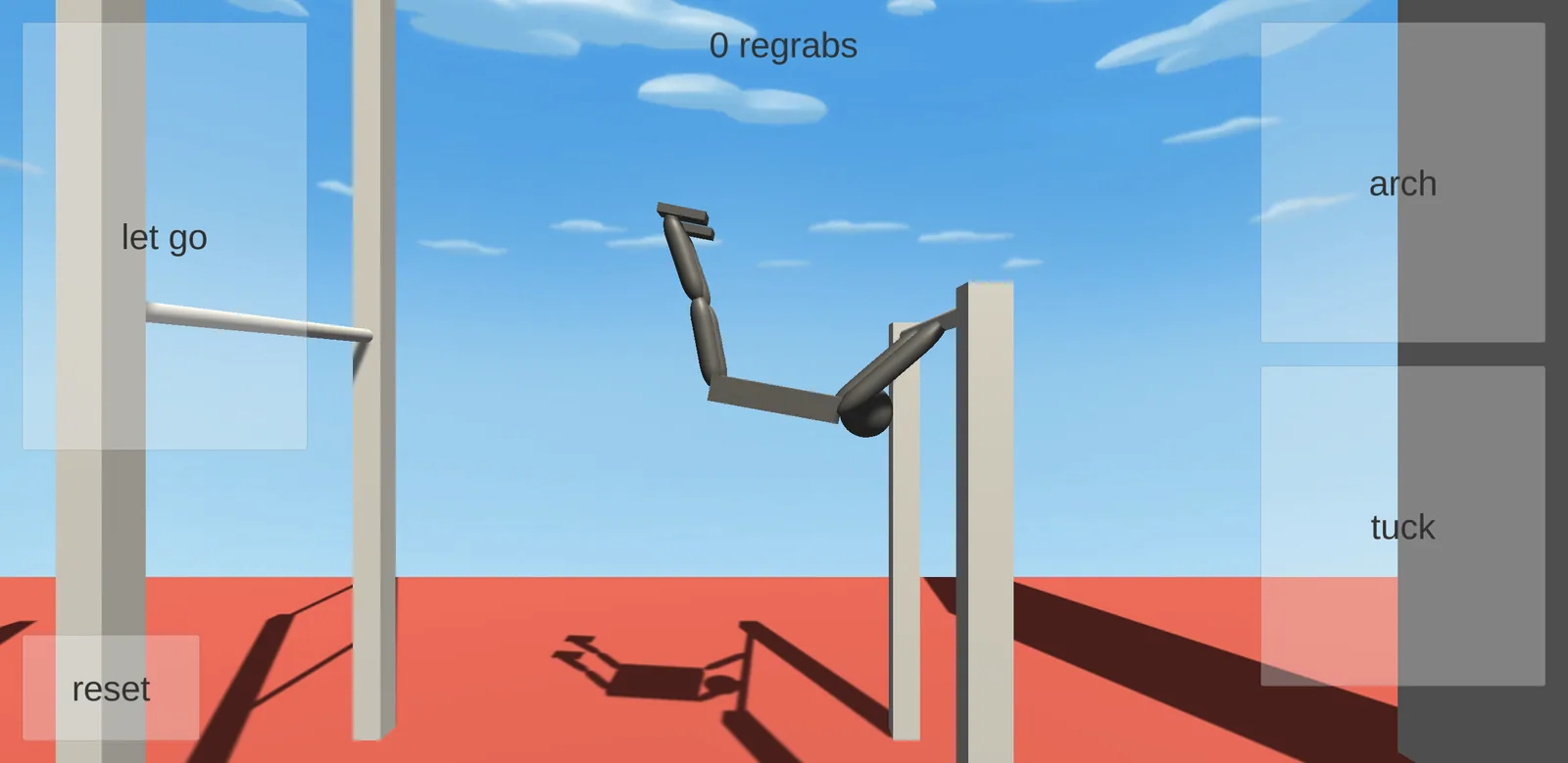
The camera sits low and to one side, a little above the red floor. Two pale uprights stand on that floor, which runs out to a hard horizon, and the bar reaches out from the near upright and stops in mid-air instead of spanning the full width between them. Above and behind there is nothing but blue and a few flat clouds. Because the figure is the only dark shape in the frame, its silhouette reads instantly: hands on the bar, hips below, feet folded underneath.
The HUD is nearly as bare. A counter at the top centre reads 0 regrabs at the start of an attempt. Four translucent targets sit at the edges with the same words as the keyboard, let go on the left, arch and tuck stacked on the right, reset at the bottom left. Nothing on screen competes with the scene for attention.
That sparseness is the part worth studying. When a scene carries no decoration, every object in it is load-bearing: the uprights act as walls, the bar is the ground you stand on, and the red plane is the consequence of missing. A platformer with painted backgrounds makes the player spend the first minute learning which pixels are solid. This one deletes that lesson and spends the budget on the swing instead.
Hanging, Airborne, on the Floor: One Bar in Three States
Which Key Closes the Gap: Noomiclone Controls in Practice
- 1
Arch
The official line is short: arch bends the body back. Read through the physics, the useful effect is reach. A body that arches extends away from the bar it is holding, which changes where the hands sit relative to the hips at the moment of release, and that changes where the figure ends up after the release. (Left arrow)
- 2
Tuck
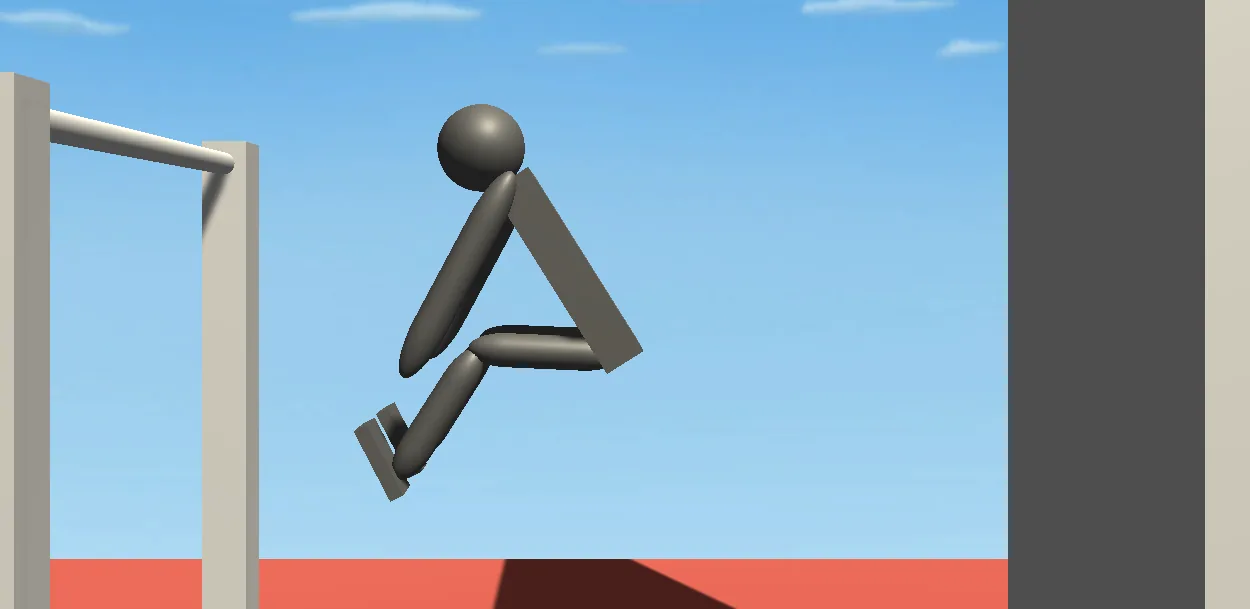
Tucking pulls the knees toward the chest. In any rotating body, pulling mass toward the axis speeds the rotation up, so tuck is the input that buys spin rather than distance. Everything the airborne screenshots show, knees at the chest and arms held wide, is one press away from the resting pose. (Space)
- 3
Let go
This is the input that starts the real attempt. The game gives no timing marker and no meter, so release timing is judged entirely by where the body lands, and the cost of being early is a swing that dies mid-air. (Up arrow)
- 4
Reset
Reset returns the figure to the bar and the counter to 0 regrabs. It is not a checkpoint and there is nothing to lose by pressing it, which is the difference between a game that punishes mistakes and one that only charges you time. (R)
Where the Difficulty Sits When the Geometry Never Moves
A fixed level has to find its difficulty somewhere other than layout, and here it comes from three things: the momentum carried into the release, the frame the release lands on, and the body shape held during the flight.
The counter at the top of the screen is the clearest evidence of what the game considers progress. It counts regrabs, not distance and not time. A regrab can only happen when a release actually connects with the far bar, so the number is a tally of completed crossings of the same gap. Nothing on the HUD rewards a longer session or a faster one.
That is a narrow definition of progress, and for this scene it is the correct one. A single-gap game has no ground to cover, so counting crossings is the only honest score it can print.
Notice what the layout does not contain: no ledges to bail out onto, no second route around the gap, no collectible that would justify a detour. Stripping those out is a choice with consequences, because it removes the fallback that makes most platformers forgiving. Miss the bar here and the run is over; there is no lower path to continue along.
Three Parts of the Scene That Decide a Run
The end of the bar
The bar stops short of the far upright. You cannot shuffle along it toward the target, so every attempt begins with a release rather than a walk, and the swing is the only way to close distance.
The gap itself
Its width is fixed, which turns it into a constant. Once the distance stops changing it becomes the ruler you measure your own swing against, attempt after attempt.
The red floor
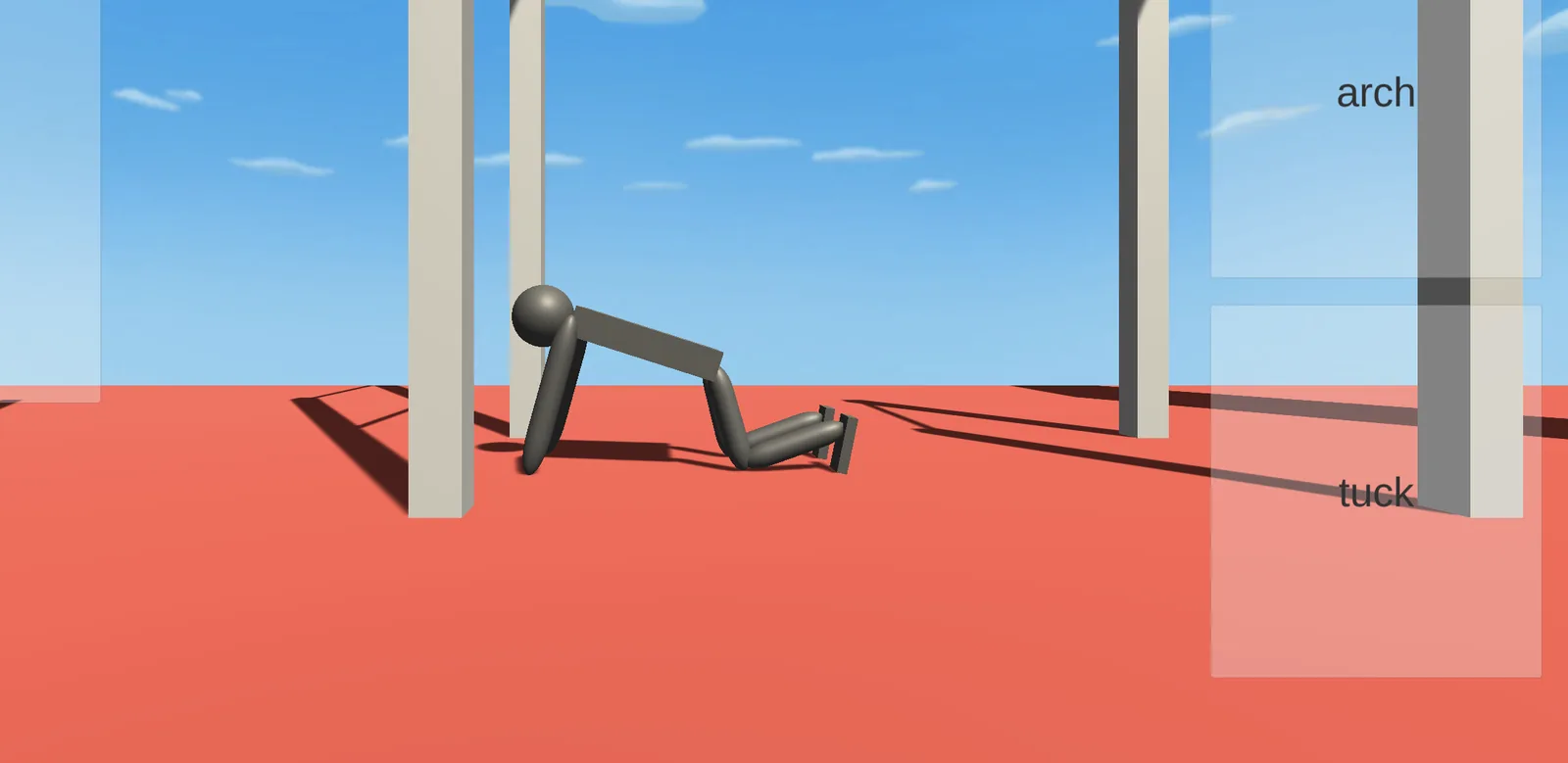
Landing ends the attempt but keeps the information. The shadow the figure casts on the floor is the only depth cue in the scene, and it is the fastest way to tell how far forward the body actually travelled.
Reset Is Not a Restart: Why the Same Stretch Is Worth Repeating
Reset puts the figure back on the bar and the counter back to zero. Nothing carries over between attempts, so a player looking for unlocks or a progress bar will find neither, and that is usually the moment the game gets closed.
The reason to stay is that the stretch is not really identical each time. The geometry is, but the swing is not, because a release that felt right at one body angle produces a different arc at another. Repeating the same gap is how you find out that your last three attempts failed for two different reasons, one of them timing and one of them posture.
There is a real difference between this and clearing ten levels in a row. A long level list teaches you the vocabulary of whoever built it, the order the hazards arrive in, the way a designer signals a jump three seconds early. One bar teaches you your own habits, and it can only do that if the surroundings stop changing long enough for a pattern to show up.
Noomiclone FAQ: Maps, Modes and the One Scene
Does Noomiclone have more than one map in the browser?
No. The web build runs a single fixed scene and has no map or mode selection, so the browser version is one gap and one bar. The mobile app is a separate and larger product, and what it adds does not carry back to this page.
What are the Noomiclone controls?
Left arrow arches, space tucks, the up arrow lets go and R resets. The same four actions sit on the screen as translucent buttons, so a mouse works too.
Is Noomiclone free to play here?
The browser build opens and plays without a purchase or an account. Nothing on the page asks you to install anything first.
Can you play Noomiclone on a phone?
The scene shows touch targets for the same four actions, so a touch layout exists. I have not tested it on phone hardware, so how the buttons feel under a thumb is not something I can tell you.
Why does a run end so quickly?
Because the floor is the only boundary. There is no health bar and no timer, so a run lasts exactly until a release fails to find the far bar, which on a first attempt is usually the first or second swing.
What does the regrab counter mean?
It counts successful catches of the bar after a release. It sits at 0 regrabs when an attempt begins and goes up each time the hands connect again, so it measures crossings of the gap rather than time survived.
Games That Give You One Stretch and Ask for a Better Run
Three more browser games on this site where the course is short and the repeat is the point.
