
Noillirk


Noillirk
Noillirk Turns Ten Daily Prompts Into a Vertical Level
Noillirk is a daily quiz that runs in the browser and keeps score in metres. Ten prompts, thirty seconds each, the same ten for everyone playing on that date. Answer with the response you think most people would give, and the game places your answer on a pre-built board of a hundred imagined players, then converts the points into altitude. A krill hanging from three balloons rises with every accepted answer.
Most quiz games end on a results screen with a number on it. This one ends somewhere on a vertical map, and the map is the part worth looking at. Eighteen named zones run from a forest pond at ground level to low Earth orbit at two thousand kilometres, and the distance between them is not evenly divided. The scoring rules and the zone list together describe a level that is deliberately uneven, in ways that decide how a run feels moment to moment.
The Eighteen Zones and the Uneven Spacing Behind Them
The climb opens at The Pond Path, which covers the first three metres. Among the Trunks takes over from 3 m to 30 m, The Treetops runs 30 m to 120 m, Over the Valley 120 m to 800 m, Into the Overcast 800 m to 2 km. Then the spacing changes character: The Snowline covers 2 to 5 km, Inside the Storm 5 to 8 km, Everest Height 8 to 9.5 km, Cruising Altitude 9.5 to 12 km and The Jet Stream 12 to 16 km.
Above that the zones stop behaving like stages and start behaving like belts. The Ozone Layer spans 16 to 30 km, the High Stratosphere 30 to 50 km, the Mesosphere 50 to 80 km, Noctilucent Clouds 80 to 100 km, the Karman Line 100 to 180 km, the Aurora 180 to 350 km, Station Orbit 350 to 450 km and Low Earth Orbit 450 to 2,000 km.
Put the numbers side by side and the design intention shows. The first three zones together are 120 metres deep, shorter than a city block laid on its end. The last zone alone is 1,550 kilometres thick, roughly five hundred thousand times the thickness of the first. Zone one and zone eighteen are both one banner and one backdrop change, but one is crossed in a single answer and the other is a place you could sit in for a long time. That mismatch is not sloppiness. A scale that mapped one metre to one metre all the way up would need a backdrop for every ten metres, and the ladder would be unreadable.
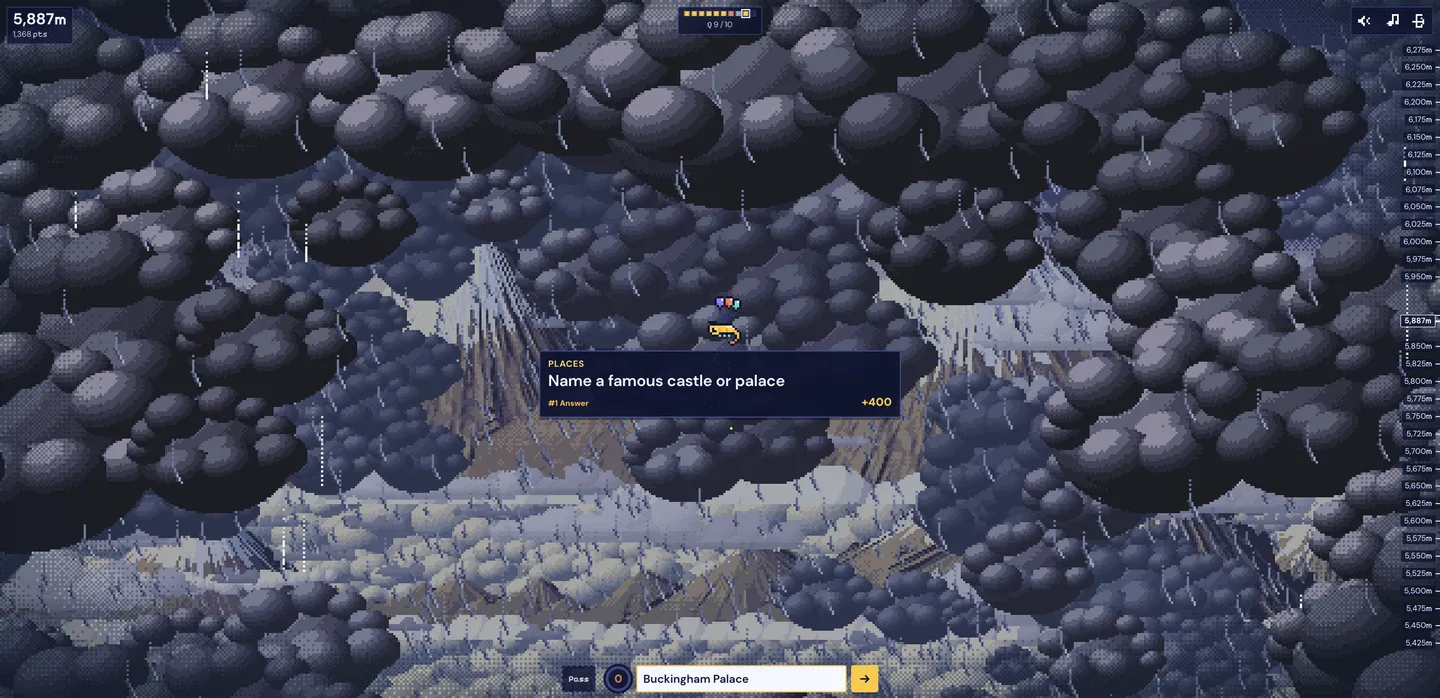
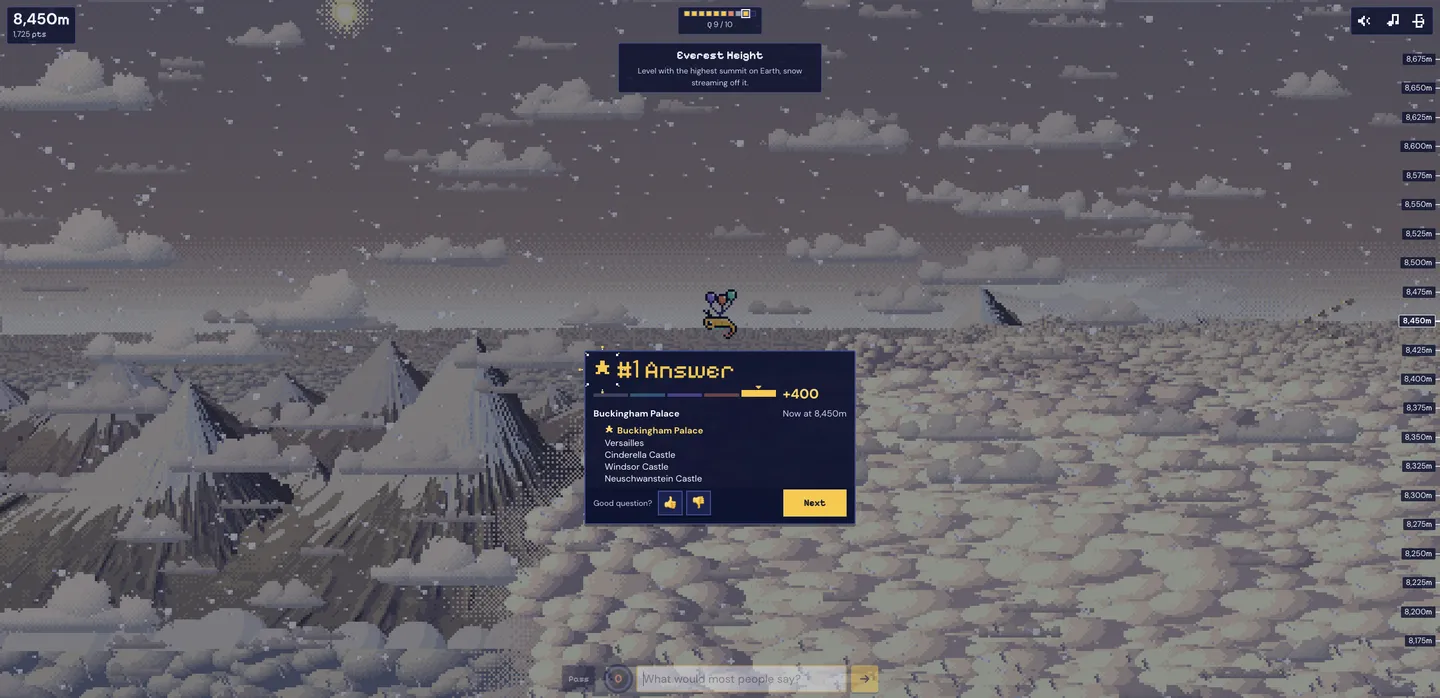
Two Frames From the Climb: Inside the Storm and at Everest Height
How Points Become Metres, and Why the Rate Keeps Rising
The conversion between score and height is not one metre per point, and the published anchors make that plain. The scoring page says a first-answer worth 100 points reaches 30 m, and a perfect Daily of 2,500 points finishes at 14.0 km. Two frames from the same run add the middle of the curve: 1,368 points sat at 5,887 m, and 1,725 points sat at 8,450 m.
Line those four readings up and the arithmetic is blunt. The first hundred points buy 30 metres. Then the curve bends: the next twelve hundred points carry the krill close to six kilometres higher, and the last eight hundred add another five and a half.
That is a defensible way to build a climb. A linear conversion would put a perfect run at fifty kilometres and the interesting zones would all sit in the first two minutes. Bending the curve keeps the pond, the trunks and the treetops close to the ground where they belong visually, and reserves the big vertical movement for the end of a run, when the score is actually worth watching.
The Weight Schedule Is the Difficulty Curve
Almost all of the climb's difficulty is carried by one table, and it has nothing to do with the scenery. Questions one and two count once, three to five count twice, six to eight count three times and the last two count four times. Ten first answers add up to 2,500 points, which is where the perfect-Daily figure comes from.
Split that total by weight and the shape of a run appears. The opening pair is worth 200 points, eight per cent of the ceiling. The final pair is worth 800, thirty-two per cent. Two questions at the top of the ladder carry as much as the first eight would if they were all answered perfectly at the base rate, which means a run is rarely decided in the first half.
There is a real cost to designing it this way, and it is worth naming. A player who starts badly has almost nothing to play for except the view, while a player who is one band off in question nine loses hundreds of points at once. The compensation is that the last two prompts feel like they matter, and a quiz where the ending feels decisive is easier to sit through than one where the score is settled by question four.
Why the Daily Stops at Zone Ten
A perfect Daily ends at 14.0 km, which is inside The Jet Stream, the tenth zone. That leaves eight zones above the ceiling of the daily format, and the official notes explain what they are for: a perfect twenty-prompt run in the practice mode reaches the mesosphere, and an endless run keeps climbing past the aurora into low Earth orbit.
So the ladder is built for more than the mode most people will play. This is a common pattern in games with a visible climb, and it usually pays off, because a ceiling you can see from below is a reason to keep going rather than a wall. It also gives the same zone list two jobs: a progress marker during a daily run and a set of landmarks for a long practice session.
The part I would question is the middle. A strong but imperfect daily likely ends in the snowline or the storm, which is where the zone banners stop arriving every few answers. From Everest Height up, the spacing is so wide that the banner becomes rare, right at the moment a run gets interesting.
The Set Closes After One Run, and That Is the Design
The daily is one shot. Everyone gets the same ten prompts on the same date, the questions change at local midnight, and progress is saved so an interrupted run can resume at the question you left. There is no second attempt at the day's set, and the streak only counts a completed daily.
That closed door is what makes the height mean anything. If you could rerun the same ten prompts until the climb looked good, the number at the end would measure patience rather than reading, and a challenge link would compare two people who had both practised the same questions. Restricting the attempt turns the climb into a comparable score, which is also why a friend's challenge on the day's prompts counts as your daily and a practice run never does.
The replay path exists, it just lives somewhere else. Practice mode offers ten, twenty or endless prompts from the same bank, and the first ten of any run are ordered from easy to hard, which is the closest thing to a designed difficulty ramp the game has outside the weight table.
What Costs You Height and What Only Costs You Seconds
- 1
Type and submit
Type the answer and press Enter, or click the arrow beside the box. On a phone the keyboard's Go key does the same job. Typing costs seconds, and seconds are the only currency the clock accepts, since a rejected answer is not penalised. (Enter)
- 2
Try again after a rejection
A refused answer shows a line saying it is not on the list and the clock keeps running. Nothing is deducted and the prompt stays open, so a fast second guess is usually better than a slow first one. (Not on our list)
- 3
Pass
Passing scores nothing for the prompt and keeps whatever height you already have. The krill never descends, so a pass is a pause rather than a loss, which changes the calculation on a question where you are sure your answer sits off the board. (Pass button)
- 4
Skip the rise
Tapping the scene hurries the ascent animation and opens the result panel, where NEXT or Enter starts the next prompt. It changes nothing about the score, only how long you wait to see it. (Tap the sky)
Noillirk FAQ: Zones, Altitude and the Daily Ceiling
How many zones does the Noillirk climb have?
Eighteen, from The Pond Path at ground level to Low Earth Orbit between 450 km and 2,000 km. Each one has its own sky, scenery and creatures, and a banner names it as the krill passes in.
How high can a perfect Noillirk run go?
A perfect daily of 2,500 points finishes at 14.0 km, inside The Jet Stream. A perfect twenty-prompt practice run reaches the mesosphere, and an endless run keeps going past the aurora into low Earth orbit.
Why does the height not rise evenly with the score?
Because the conversion steepens. The scoring page puts 100 points at 30 m and 2,500 points at 14.0 km, and two frames from a single run put 1,368 points at 5,887 m. The same number of points is worth far more height at the end of a run than at the start.
Do I lose height for a wrong answer?
No. An answer the game rejects costs time and nothing else, and a pass or a timeout scores zero without touching the height already gained. The climb only ever goes up.
Is Noillirk free and does it need an account?
It is free, and there is no sign-up. Progress, best heights and the streak are stored in the browser, so they do not follow you to another device or a private window.
Can I play the same ten prompts twice?
Not the day's daily. The set belongs to the date and you get one attempt, though a friend's challenge on those prompts counts as your daily if you have not finished it. Practice prompts are repeatable and never affect the streak.
Games Built Around a Ladder Instead of Levels
Three more browser games on this site where the same course is measured again and again.
